
Compare the information being delivered
A company introduction can be the same for every visitor. An account balance cannot. A stable product description differs from stock availability that changes with every order. Start with these distinctions, then decide which information can be prepared ahead of time and which must come from a current authorised source at the moment it is used.
A clearer picture
What happens when someone visits?
A website can prepare its pages before a visit, or assemble a response when a request arrives. The difference is where the work happens—not whether the design looks modern.
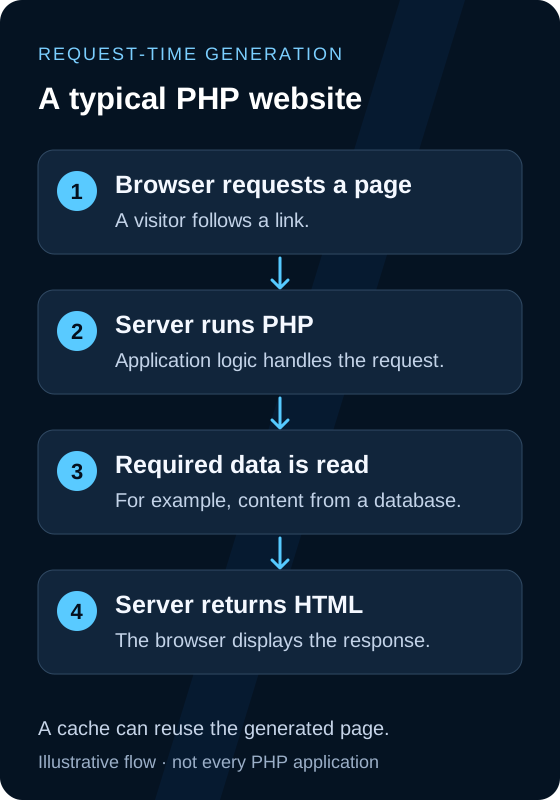
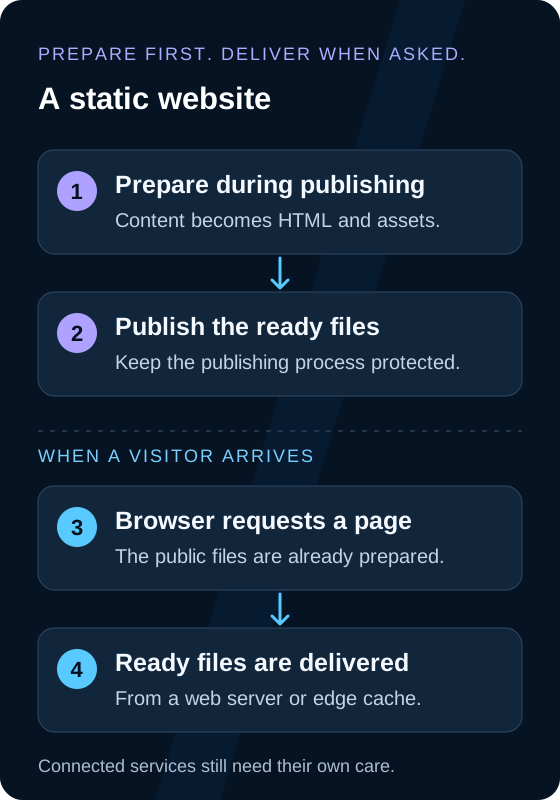
A delivery model alone does not guarantee speed or security. Images, scripts, caching, hosting, access and connected services all affect the result.
Compare performance, security and ongoing care ↗Compare the people operating the site
Frequent publishing by a large team may justify a dedicated editorial environment. Occasional updates to a compact service site can use a simpler review process. Include access management, training and maintenance responsibilities in the comparison. A design that looks easy to use can still be difficult to operate if nobody owns the update workflow.
Compare the complete solution
Performance, resilience and security depend on the finished implementation, assets and connected services. Neither label proves quality. A prepared public site can link to an existing booking application, while a dynamic platform can serve well-optimised pages. Compare equivalent visitor tasks and ongoing responsibilities, rather than a lightweight brochure against an unrelated complex shop.
A side-by-side decision.
| Decision | Prepared public pages | Live application workflow |
|---|---|---|
| Public information | Company, service and approved product information prepared ahead of visits. | Content can be assembled from current data when a visitor requests it. |
| Accounts and transactions | Link to or integrate an appropriate operational service when separately scoped. | Requires suitable authentication, permissions and transaction handling. |
| Content changes | An agreed publishing and review workflow; not necessarily a self-service editor. | An editorial interface may suit frequent changes, with training and access management. |
| Performance and care | Measure the finished pages, images and connected services. | Measure the same tasks; caching, assets and implementation still matter. |
Example: a manufacturer choosing the right split
Illustrative scenario: a manufacturer wants approved specifications, case photographs and quotation enquiries on its public website, while existing customers order through a private portal. Prepared public pages can present the catalogue and link clearly to the established portal. Stock, customer pricing and order acceptance stay in the operational system. This is a planning example, not a claim about a client project.
A practical next step
What to prepare.
- Information matrix
Mark each content type as stable, frequently edited, live or private.
- Operator roles
Identify editors, approvers and owners of transactional systems.
- Comparable scope
Request proposals that solve the same visitor tasks and include ongoing duties.
Questions worth asking.
Is static always faster?
No. Large images and excessive scripts can make any site slow. Measure the actual pages and conditions.
Can both approaches coexist?
Yes. The hand-off between public content and operational applications needs clear ownership and testing.
Which is cheaper?
That depends on scope, content work, integrations and maintenance. A delivery label is not a quotation.
Sources & further reading.
Primary documentation for the factual background. Our project recommendations depend on your requirements.
MDN — Introduction to the server side Technical background for the delivery distinction, not evidence that one approach always performs better.