
Where the page preparation happens
In a typical database-backed PHP application, a request reaches a server, the application applies its logic, reads the required data and assembles a response. A page cache can reuse an earlier response instead of repeating that work. PHP can also generate files ahead of a request, so the programming language alone does not tell you how a particular site is delivered.
For a prepared static website, public HTML and assets exist before the visit. A web server or an edge cache sends those files when requested. Content changes still need a publishing process. A booking service, account portal or live product feed remains a separate operational dependency; moving the public pages does not remove the responsibilities of that service.
A clearer picture
What happens when someone visits?
A website can prepare its pages before a visit, or assemble a response when a request arrives. The difference is where the work happens—not whether the design looks modern.
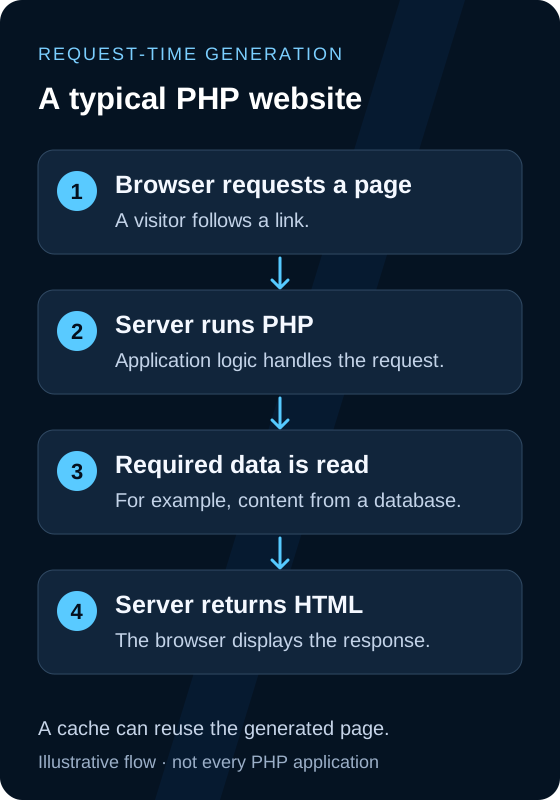
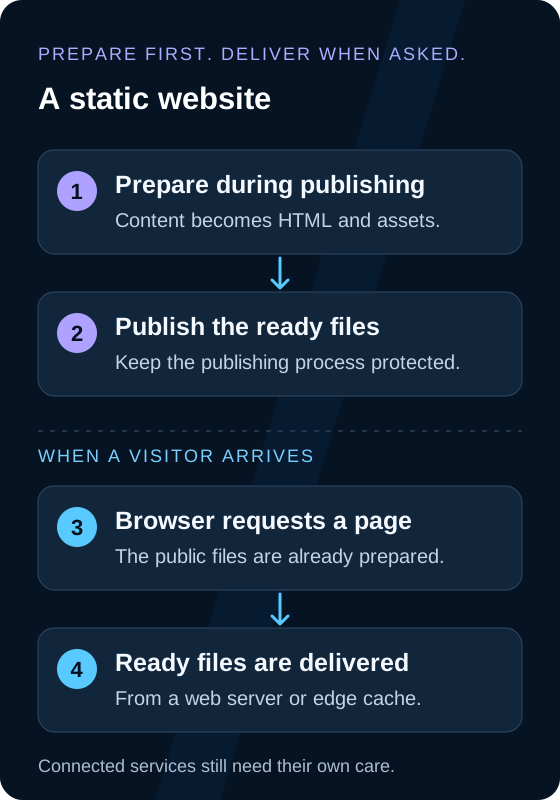
A delivery model alone does not guarantee speed or security. Images, scripts, caching, hosting, access and connected services all affect the result.
Compare performance, security and ongoing care ↗Compare exposed components, not “safe” and “unsafe” labels
An application that accepts requests, processes input and reads a database needs protections appropriate to those operations. Injection, access-control mistakes, unsafe output and vulnerable dependencies are examples of issues that depend on the application and its components. They are not proof that every PHP website is vulnerable. Supported software, careful implementation, permissions, updates and defence in depth matter.
A public site serving prepared files does not need those request-time application and content-database components for the same page delivery. Removing an unnecessary component can remove that particular attack path. Hosting accounts, domain control, the publishing process, third-party scripts and connected APIs can still be compromised. Client-side code can still create risks such as unsafe handling of untrusted data. “No PHP” is not a substitute for protecting the complete service.
Measure speed using equivalent tasks
Prepared files can make delivery predictable and work well with caching. A well-configured PHP site can also use page caches and a delivery network. An oversized image, a slow font, blocking scripts or an overloaded browser can make either approach feel slow. Server response time is only one part of what the visitor experiences.
Compare the same page purpose, content, geography, cache state and test profile. Record loading, interaction and layout stability rather than presenting a single score as a permanent guarantee. Laboratory tests help diagnose a change; field measurements describe real visits when enough data exists. Neither is evidence of higher revenue by itself.
Maintenance changes shape; it does not disappear
An application-backed site may need runtime, extension, database and access maintenance as well as content work. A prepared public site still needs protected hosting and publishing access, dependency review where applicable, domain renewals, updated business content and a recovery plan. External forms, payments or booking tools each have their own lifecycle.
The useful decision starts with visitor tasks and content ownership. A company presentation or quotation-led catalogue may fit prepared delivery. User accounts, personalised information and frequent multi-editor publishing can justify additional operational systems. A migration assessment should identify what remains, what changes and who will be responsible before promising a simpler future.
A side-by-side decision.
| Consideration | PHP application example | Prepared static public pages |
|---|---|---|
| Per-request work | May execute application logic and read data; a cache can reuse the response. | Serve files prepared earlier; any connected live service is assessed separately. |
| Database and server input | Protect queries, permissions, validation and the exposed application. | No content database is needed for that page request; external APIs may still use one. |
| Unsafe browser code | Protect output and client-side handling of untrusted content. | The same browser-side care applies; static delivery does not prevent every XSS risk. |
| Access and supply chain | Protect hosting, application accounts, dependencies and deployment. | Protect hosting, publishing, dependencies and domain access. |
| Speed | Depends on implementation, caching, server, assets and visitor conditions. | Depends on delivery, caching, assets, scripts and visitor conditions. |
| Updates | Runtime, extensions, data and content may require ongoing care. | Content, publishing, delivery and connected services still need care. |
Example: preserve the operational system
Illustrative scenario: a service company has a public website and an existing customer booking system. Its public service pages may be prepared and delivered separately, while confirmed appointments remain in the booking system. The assessment must preserve the hand-off, privacy responsibilities and important URLs. The result is a scoped division of responsibilities, not a claim that static files replace live availability or customer accounts.
A practical next step
What to prepare.
- Inventory the request path
Identify public page generation, data stores, caches, scripts and operational services.
- Compare like for like
Use equivalent content, cache conditions, location and device profile before interpreting performance numbers.
- Assign responsibility
Name the owners of publishing, hosting, accounts, integrations and recovery.
- Keep useful functionality
Assess actual tasks and dependencies before planning a migration or removing a working system.
Questions worth asking.
Does PHP make a website insecure?
No. Security depends on the implementation, exposed components, configuration, access and maintenance. The language alone is not a vulnerability finding.
Does a static website need security updates?
It still needs care for publishing tools and dependencies where used, delivery infrastructure, access and connected services. Removing a public runtime does not remove every risk.
Is a static website always faster?
No. Compare the delivered experience under equivalent conditions. Cached PHP pages can be fast; large images or excessive scripts can slow prepared pages.
Sources & further reading.
Primary documentation for the factual background. Our project recommendations depend on your requirements.
PHP manual — What is PHP? Primary description of PHP and server-side execution; not a security judgement.PHP manual — Security Primary security guidance for application and runtime considerations.MDN — HTTP caching Caching can affect both generated and prepared responses.OWASP — Top 10 Application risk categories require assessment; they are not a PHP-only vulnerability count.web.dev — Core Web Vitals Loading, interaction and stability metrics for the delivered experience.